


No official standard defines them, but the working set is fifteen products: primer, foundation, concealer, setting powder, blush, contour, highlighter, eyeshadow, eyeliner, kajal, eyebrow pencil, mascara, lipstick, setting spray and tools. A shorter version works too. Primer, foundation, concealer, powder, blush, mascara and lipstick cover almost any everyday occasion, which is why most guidance on a makeup kit list for girls begins there.


Makeup Essentials List: 2026 Buying Guide
A complete makeup essentials list for 2026, with the shelf-life, skin-type and tax details that decide what you should actually buy, and how much of it to stock.
Key Takeaways
• Most kits fail on quantity, not choice. Mascara needs replacing every three to four months while lipstick lasts up to twenty-four, so equal-quantity buying guarantees waste.
• One cosmetics invoice can straddle two tax slabs. Face powder and talcum powder moved to 5% in September 2025, while foundation, lipstick and mascara stayed at 18%.
• You can identify a silicone-based product in three seconds. Scan the first five ingredients for anything ending in -cone or -siloxane, then match your base layers accordingly.
Walk into any beauty store with a long shopping list and you will leave with products you never finish. That is the real problem with most makeup buying: not picking the wrong shade, but buying items that dry out or expire before they are used up. Beginners do it with their first kit. Salon owners and retailers do it at a much more expensive scale.
A good makeup essentials list solves half of that. It tells you what belongs in the bag. The other half is knowing how fast each item turns over, which skin type it suits, and which base it will layer with.
This guide covers both. You will get the complete makeup products list, broken down by face, eyes, lips and tools, followed by the filters that decide quantity. Treat it as a beauty essentials list you can buy from. If you are buying for a salon, a studio or a shop floor, you can source every item on this cosmetics list as wholesale beauty products on Amazon Business.
Basic Makeup Essentials List for Beginners
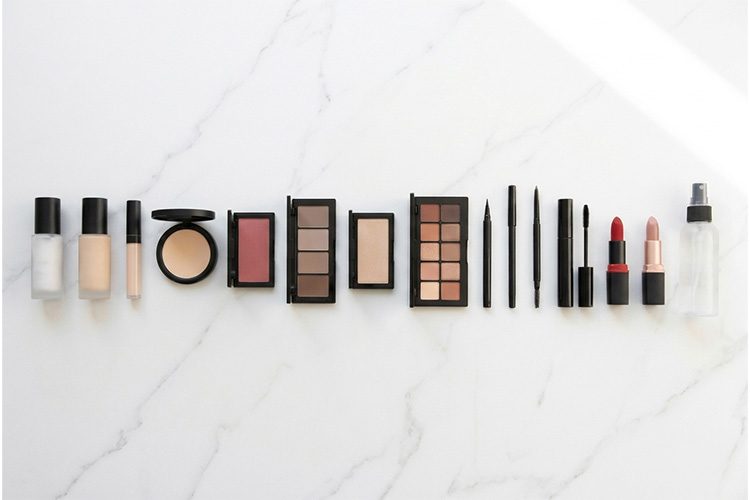
There is no official list, so here are the fifteen items we would put in a basic makeup kit, in the order you apply them. This basic makeup essentials list adds one column most guides leave out. Period After Opening, or PAO, is how many months a product stays safe once the seal is broken. It appears on the pack as an open-jar symbol with a number and the letter M, so 12M means twelve months from opening.
# | Item | What it does | Typical PAO |
1 | Face primer | Smooths the surface so foundation sits flat and holds longer | 6 to 12 months |
2 | Liquid foundation | Evens skin tone and cover redness, marks and pigmentation | 6 to 12 months |
3 | Concealer | Lifts dark circles and spots with heavier coverage in a small area | 6 to 12 months |
4 | Setting powder | Locks the base, cuts shine and stops creasing | 12 to 24 months |
5 | Blush | Returns colour to the cheeks after the base flattens the face | 12 to 24 months |
6 | Contour | Adds shadow to define the jaw, nose and cheekbones | 12 to 24 months |
7 | Highlighter | Catches light on the cheekbones, brow bone and nose bridge | 12 to 24 months |
8 | Eyeshadow palette | Builds depth and colour on the lid, from matte to shimmer | 12 to 24 months |
9 | Eyeliner | Defines the lash line in pencil, gel or liquid | 3 to 6 months liquid, 12 to 24 months pencil |
10 | Kajal | Lines the waterline for the dense finish Indian looks rely on | 4 to 6 months |
11 | Eyebrow pencil | Fills gaps and holds the brow shape that frames the face | 12 to 24 months |
12 | Mascara | Lengthens and darkens lashes, and the shortest-lived item here | 3 to 4 months |
13 | Lipstick | Adds colour and definition in matte, satin or glossy finishes | 12 to 24 months |
14 | Setting spray | Melts the powder layers together and holds the finish | Around 6 months |
15 | Makeup tools | Brushes, sponges and applicators that control how everything blends | No PAO, replace on wear |
Read the last column before the first. A makeup essentials list for beginners that ignores shelf life produces the same result every time: a drawer of half-used powder and dried-out mascaras.
The spread matters more than any single number. Mascara needs replacing every three to four months, liquid eyeliner every three to six, lipstick every twelve to twenty-four. Powders sit at the long end because a dry formula gives bacteria far less to work with. For one person that means buying mascara more often. For a salon or a shop, it rewrites the order sheet. Buy mascara and lipstick in equal quantity and you will finish the mascara four to six times over while the lipstick ages.
The fix is to split the order by turnover speed rather than category. Fast movers get frequent small orders, slow movers larger and less frequent ones, which is where bulk purchasing earns its discount without creating dead stock. That turns a makeup items list into a stocking plan. Makeup products for beginners and professional kit essentials hold the same items; only the quantities change. A salon carries two or three fast movers, so a dried-out mascara never costs a booking, while a retailer goes deep on shades, not categories.
For a shorter makeup list for beginners, the first five rows plus mascara and lipstick carry a complete everyday look. Everything else on this makeup products list for beginners is an upgrade. Two makeup kit essentials for beginners deserve a note. Setting spray lasts about six months, so buy the smaller size. Brushes have no expiry, which makes them the safest first upgrade on any basic makeup kit.
Face Makeup Products
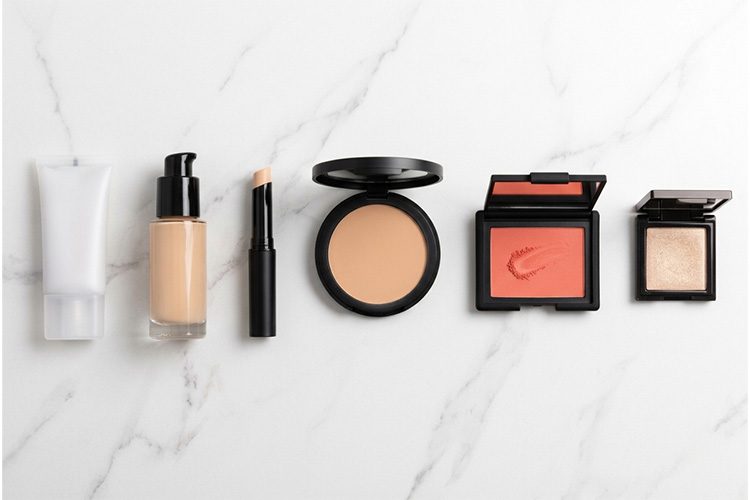
Face makeup is the layer everything else sits on, and where most of your money goes. Get the base wrong and no amount of eye or lip work rescues the finish. These are the basic makeup products that build it, in application order.
Primer fills fine texture and pores, so the next layer sits flat. Foundation evens the overall tone. Concealer covers dark circles and specific marks with a heavier, smaller application. Setting powder holds the base, and blush, contour and highlighter put the dimension back, because an evened-out face reads flat without them.
Foundation comes in more formats than most lists admit. Liquid is the default. Powder and compact suit oily skin and travel better, sticks give heavy coverage in a small format, and tinted moisturisers or BB creams handle base and skincare at once. Stocking across that range beats stocking many shades of one format.
Colour correctors handle what concealer cannot. Green cancels redness, peach and orange counter blue-toned dark circles, lavender lifts dullness. They go under foundation, never over it, and belong on a professional face makeup products list rather than a first one. Two notes separate a working list of essential makeup products from a generic one.
Formula decides shelf life. Liquid foundations and concealers run six to twelve months after opening. Powder foundations stretch towards twenty-four, because a dry formula is harder on bacteria, so they tolerate a longer order cycle.
Face powder sits in a different tax band from the rest of the base. The Goods and Services Tax (GST) rate changes of 22 September 2025 moved face powder and talcum powder down to the 5% slab. Foundation, concealer and the rest of the colour cosmetics stayed at 18%. A single basket can therefore carry two different rates on one invoice, which your accounts team needs to know before reconciliation, not after.
Eye Makeup Essentials
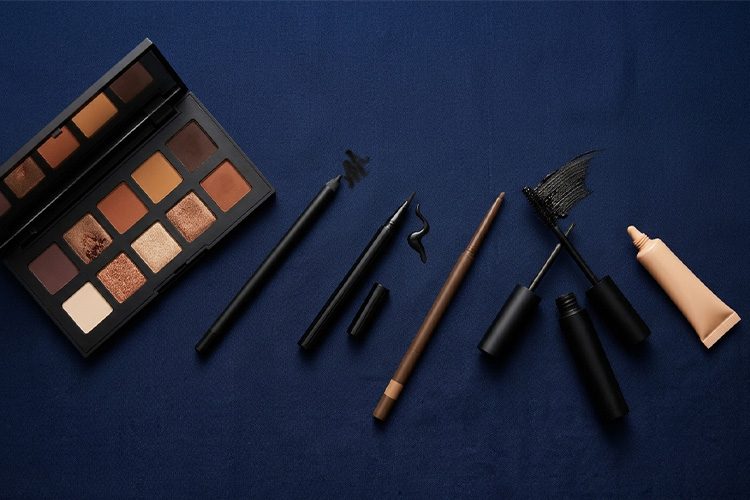
Eye products are the fastest-moving part of any kit, and the part people most often keep too long. This eye makeup products list covers the seven items that do the work, with the replacement windows that matter.
Eyeshadow palette. Matte and shimmer shades for building depth on the lid. Powder formulas hold for twelve to twenty-four months, so one good palette outlasts several mascaras.
Eyeliner. Pencil, gel and liquid define the lash line but do not age alike. Pencil runs twelve to twenty-four months. Liquid behaves like mascara: replace it every three to six months, because the wet formula is an easy target for bacteria.
Kajal. Applied to the waterline, kajal delivers the dense definition Indian eye looks are built around. It sits closer to the eye than anything else in the kit, and Indian beauty brands put its replacement window at four to six months.
Eyebrow pencil. Fills gaps and holds the shape that frames the face. Expect twelve to twenty-four months.
Eye primer. Routinely skipped, and the reason eyeshadow creases by midday on oily lids. It gives powder something to grip. Optional in a first kit, necessary in a professional one.
False lashes. Not an everyday item, but standard in a working artist's kit. It is the adhesive, not the lash, that behaves as the consumable.
Mascara. The shortest-lived product in the kit, at three to four months. After that it dries, clumps and carries more bacteria on the wand with every use.
In practice, one eyeshadow palette outlives three to six of the mascaras beside it. Buying for a salon station or for resale, those two belong on completely different reorder schedules.
Lip Makeup Essentials
Most people own too many lipsticks. Lip colour lasts longer than anything else in the kit, so shades pile up faster than they get finished. Lips are the slowest-moving part of any makeup essentials list, which changes how you buy them. This lip makeup products list keeps to items that each do a distinct job.
Lip balm prepares the surface. Dry, flaking lips make every other lip product look worse, so balm is a prep step, not a finishing one.
Lip liner holds the edge, stopping colour bleeding and letting you adjust the lip line before colour goes on.
Lipstick carries the colour in matte, satin or glossy finishes, and is the most forgiving item you can stock at twelve to twenty-four months.
Lip gloss adds shine over lipstick or on bare lips. It runs shorter at six to twelve months, because the liquid formula and the applicator wand behave more like a mascara than a solid bullet.
Lip tint or stain stains rather than coats. That is why it survives tea, water and a full working day better than a bullet lipstick, and why it has become the default daily lip product for many buyers.
Lipstick is the slowest-moving item in the kit, so it is the one product where a larger order genuinely pays off. Gloss needs a tighter cycle, balm the tightest. Stocking for resale, lip colour is where shade depth sells and format breadth does not.
Makeup Brushes & Tools
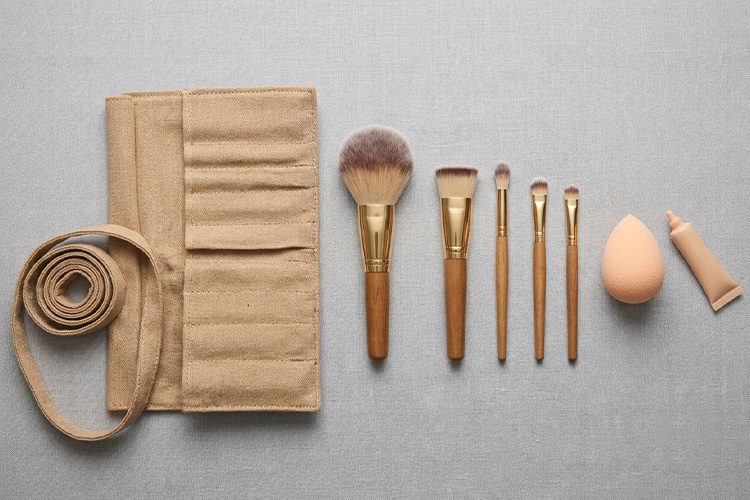
Buy a good foundation, apply it with a bad brush, and you will blame the foundation. Any makeup essentials list that stops at product is only half a kit. This makeup brushes list covers the set that earns its place.
Brushes
A beginner does not need a twenty-piece set. Four brushes cover almost everything:
• Foundation or flat buffing brush. Presses liquid base into the skin rather than dragging it across.
• Concealer brush. Small and firm, for precise placement under the eyes and on marks.
• Powder brush. Large and loose, for setting powder and blush without laying down too much product.
• Eyeshadow brush pair. One flat shader to pack colour onto the lid, one fluffy blender to soften the edges.
A professional kit adds a highlighter brush, a spoolie, a crease brush and a detail brush. That is a working station, not a starter set.
Sponges and applicators
A damp teardrop sponge presses foundation in for a sheerer finish than a brush gives. Silicone and microfibre sponges do similar work with less absorption. Most people use both: a brush to place product, a sponge to blend it.
Sponges need more care. A damp sponge holds moisture and product at once, which makes it the easiest item to keep past its useful life. Wash brushes and sponges regularly and dry them flat, so water does not run into the ferrule and loosen the glue holding the bristles.
Storage and transport
A makeup tools list is incomplete without something to carry it in. Roll-up pouches, clear cases and compartment organisers all work, and a hard case stops brush heads splaying, the most common way a good brush dies early.
Tools have no Period After Opening; a brush fails from wear and hygiene, not a date on the pack. That makes them the one genuinely slow-moving line in the category, and a sensible one to order in volume. If you repack kits for resale or ship them to clients, packaging supplies on Amazon Business cover the cartons, tapes and protective material that keep brush heads in shape.
Everyday Makeup Essentials
Daily makeup is a subtraction problem. The everyday makeup essentials list holds the items you will genuinely finish, which makes them worth buying well. A daily makeup essentials list is shorter than a complete one, and that is the point.
Seven products cover a complete daily look:
• Sunscreen or a tinted moisturiser. The base step that doubles as light coverage.
• Concealer. Targeted, not all-over. Faster than foundation on a weekday morning.
• Compact or setting powder. The step that holds everything in place.
• Blush. Restores colour in one pass.
• Kajal or a soft eyeliner. Definition without a full eye look.
• Mascara. The highest visible return of any single product.
• Lip balm or a tinted lip shade. Comfort first, colour second.
Notice what is not there. No contour, no highlighter, no false lashes, no setting spray. Those are occasion products, and treating them as daily makeup products is how a six-minute routine turns into twenty.
Setting is the step most people skip and most Indian buyers cannot afford to. In humid conditions a base left unset slides, which is why a look that held in an air-conditioned office falls apart on the commute home. These are the must have makeup products for daily use.
For resellers, makeup products for daily use are repeat-purchase lines with predictable demand, a steadier base for your order book than occasion-led shades. The everyday makeup essentials for women buying for themselves are, almost exactly, the fastest-turning lines on a retail shelf.
Party Makeup Essentials
Occasion makeup has to survive hours of heat, photography and movement, which changes the formula brief. The party version of a makeup essentials list is not longer, it is tougher. The makeup essentials for party looks are different versions of the same products.
This party makeup products list adds the long-wear layer on top of the daily kit:
• Gripping or mattifying primer, to hold a heavier base
• Full-coverage foundation, usually in a longer-wearing formula
• Colour corrector and concealer, for photography that shows every shadow
• Setting powder plus setting spray, used together rather than as alternatives
• Contour and highlighter, because event lighting flattens features
• Eyeshadow palette with shimmer, false lashes and a waterproof mascara
• Smudge-proof kajal and a transfer-resistant lip colour
Formula does most of the work here. Silicone based makeup is the usual answer for events. The silicone layer sits on the surface instead of absorbing in, which gives the matte finish and long wear an eight-hour function demands. The trade-off is that it feels heavier.
Bridal work sits at the far end. A bridal kit holds through a full day of heat, photography and tears. Waterproof and transfer-resistant formulas replace their everyday equivalents, and the artist carries backups of the fast movers.
For a salon, the harder problem is timing. Party and wedding demand arrives in bursts around the festive calendar. The same makeup kit list that sits idle in July is the one you cannot restock fast enough in November. Working out those peaks is an inventory planning exercise, and the difference between a busy season and a profitable one.
Makeup Essentials for Different Skin Types
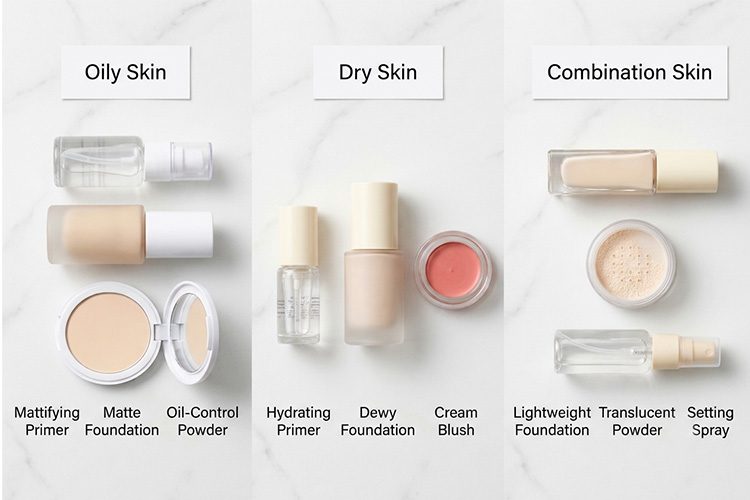
Two people can buy the same foundation and get two different results. Formula is usually the reason, which makes choosing makeup products for different skin types the highest-return filter you can apply.
Oily skin
Oily skin breaks down a base from underneath, so the kit controls shine rather than adding moisture. Makeup products for oily skin lean matte and oil-free:
• Mattifying primer
• Matte or oil-free liquid foundation
• Oil-control setting powder and compact
• Powder blush rather than cream
• Waterproof eye primer and smudge-proof kajal
• Matte lipstick
Silicone-based formulas suit oily and combination skin, because the surface layer resists oil. For acne-prone customers, check the pack says non-comedogenic; some silicones block pores.
Dry skin
Powder settles into fine lines and emphasises flaking, so the dry-skin version of a makeup essentials list works best in creams and liquids. Makeup products for dry skin to stock:
• Illuminating or hydrating primer
• Hydrating or dewy-finish foundation, or a tinted moisturiser
• Liquid concealer
• Cream blush and cream contour
• Liquid highlighter
• Creamy or satin lipstick
Emollient formulas stay moist on the skin instead of drawing moisture out.
Combination skin
Combination skin is two skin types at once, usually an oily T-zone with drier cheeks. Zone the products:
• Mattifying primer on the T-zone only
• Lightweight, oil-free foundation across the face
• Hydrating concealer on the drier areas
• Translucent powder on the T-zone, not all over
• Cream or liquid highlighter on the cheekbones
• Setting spray to bring the two zones together
Sensitive and normal skin
Sensitive skin reacts to ingredients more than texture. Mineral formulas, built from finely ground minerals and not oils, are widely recommended here, because they sit on the surface and carry fewer irritants. That is industry guidance, not clinical consensus. Approach formulas containing alcohol carefully, since alcohol commonly triggers redness.
Normal skin is the easiest to buy for, and to over-buy for. Almost anything works, which is why the shelf-life and base-matching filters matter more.
Makeup essentials for Indian skin
Two factors matter most. Undertone comes first: Indian skin tones span a very wide range, and undertone varies as much as depth. Match on depth alone and a foundation can still read too orange or too ashy once it settles, so always test along the jawline in daylight.
Climate comes second. Sweat and heat break down even a well-applied base, which makes primer, setting powder and setting spray far more useful here than they sound.
Skin type is also a demand signal. Shade and formula demand varies sharply by region and season, and the business analytics tools on Amazon Business show which lines actually move for your buyers.
How to Choose Makeup Products
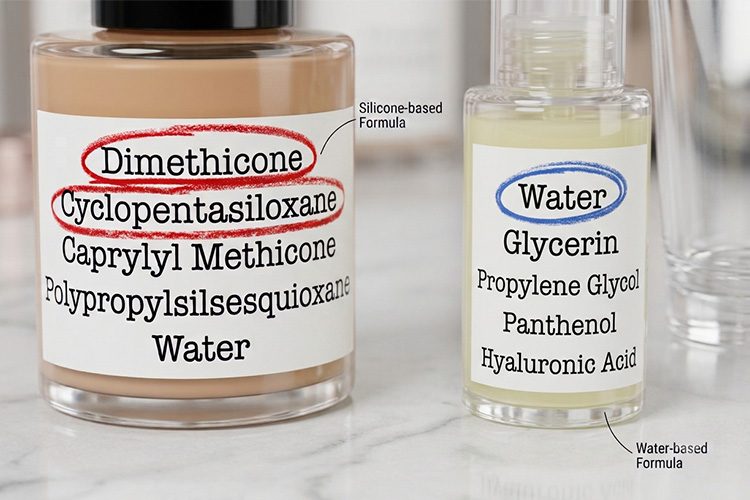
This is the part most guides leave out. A cosmetic products list tells you what exists. Four filters turn a makeup essentials list into a basket.
Filter 1: Match the base type
Mismatched bases are the commonest cause of makeup failing within the hour. Water based makeup and silicone-based makeup do not bind, so layering one over the other makes the top product roll into balls or patch instead of gripping. That reads as a faulty product. It is really a layering error.
Identifying the base takes three seconds. Check the first five ingredients: anything ending in -cone or -siloxane means silicone based, while a list led by water, glycerine and hyaluronic acid means water based.
| Water based makeup | Silicone based makeup |
Key ingredients | Water, glycerine, hyaluronic acid | Dimethicone, anything in -cone or -siloxane |
Finish | Natural and lightweight | Smooth and matte |
Best suited to | All skin types, including sensitive and acne-prone | Oily, combination, textured skin |
Best used for | Everyday wear | Events and long-wear days |
Pairs with | Water-based or mineral foundation | Silicone-based liquid or cream |
Sensitive skin friendly | ✅ | ❌ |
Keep the chain consistent. Moisturiser, primer and foundation should share a base type, or you have only moved the mismatch down a layer.
Filter 2: Read the Period After Opening
Whether a pack carries the open-jar symbol depends on where it was labelled. Under European Union rules it appears only on cosmetics with an unopened shelf life above thirty months; below that a printed date replaces it. Indian rules differ: the Cosmetics Rules, 2020 require a manufacturing date and an expiry date on every cosmetic. Both conventions appear on an Indian shelf, because imported stock carries the labelling of the market it was packed for.
For one user this decides when to throw something away. For anyone buying stock it decides order size, and it is the fastest way to stop money sitting on a shelf as expired cosmetic essentials.
Filter 3: Know which tax slab applies
The GST changes of 22 September 2025 cut four slabs of 5%, 12%, 18% and 28% to a two-tier system of 5% and 18%, plus a 40% rate for luxury and sin goods. The 28% rate cosmetics buyers used to plan around no longer applies here.
Most makeup sits at 18%, under Harmonised System of Nomenclature (HSN) code 3304. Several personal care lines moved to 5%: hair oil, shampoo, shaving cream, toothpaste, talcum powder and face powder.
A valid tax invoice lets a registered business claim Input Tax Credit (ITC) at the rate charged: up to 18% on most colour cosmetics, 5% on merit-rate lines. That cuts landed cost, not the price. Every eligible order on Amazon Business carries GST invoices.
Filter 4: Check the compliance basics
Cosmetics sold in India are governed by the Cosmetics Rules, 2020, which put manufacture, import, testing, labelling, distribution and sale under one framework overseen by the Central Drugs Standard Control Organisation. Imported cosmetics need an import registration certificate, label content sits under Rule 34, and pack-level declarations under the Legal Metrology (Packaged Commodities) Rules, 2011.
If you resell, particularly anything imported, confirm your position with a compliance or tax advisor before committing to volume. This makeup buying guide tells you the filters exist, not how they apply to your registration.
Conclusion
A makeup essentials list is only useful once you know what to do with it. Choosing the fifteen items is the easy part. Match base types so products do not pill. Respect Period After Opening so stock does not expire unsold. Know which slab each line falls into. Those three decisions turn a shopping list into a buying plan.
Use this as a makeup checklist, not a wish list. Buy fast movers often and slow movers in volume, and the same beauty essentials list that produced a cluttered drawer starts producing margin instead.
You get wholesale pricing across 15+ crore products, GST invoices on every eligible purchase and more than 3.5 lakh sellers to source from. To stock your beauty range in one place, register with Amazon Business.
FAQs
Have questions?
